

Bionews Releases Inaugural Rare Trust in AI Index, Finds Low Confidence in AI Among Rare Disease Patients
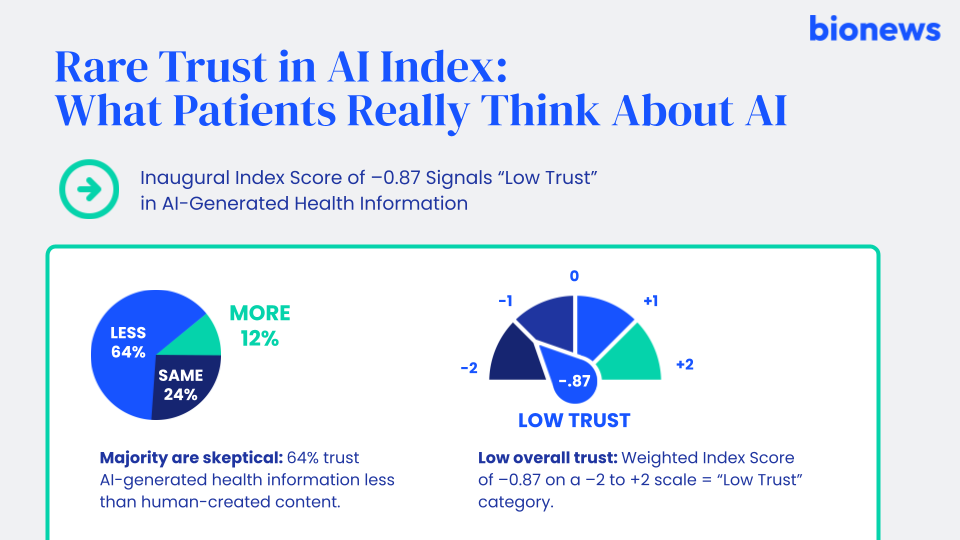
The Index Shows Low Trust in AI for Rare Disease Patients

Bionews Logo
With an initial index score of –0.87, the report highlights both the trust gap and the emerging opportunities for AI to support patients more effectively.
Lived experience will always remain core to health decision-making, and AI has the potential to amplify, not replace, that insight.”
PENSACOLA, FL, UNITED STATES, December 10, 2025 /EINPresswire.com/ -- Bionews, a leading rare disease news and community network, today announced the release of its inaugural Rare Trust in AI Index, a new quarterly research initiative examining how patients and caregivers in the rare disease community assess the trustworthiness of AI-generated health information compared with human-created content.— Chris Comish, CEO and Founder of Bionews
The first index reveals that a majority of rare disease patients remain skeptical of health information generated by artificial intelligence, even as AI tools become more visible in healthcare. The survey, conducted across the rare disease communities on the Bionews platform, included responses from 235 participants.
According to the findings, 64 percent of respondents reported trusting AI-generated health information less than information created by humans. Twenty-four percent reported equal trust in both sources, while 12 percent said they trust AI-generated information more. The weighted Index Score of –0.87, based on a scale from –2 to +2, places overall trust firmly in the “Low Trust” category.
At the same time, Bionews research shows that generative AI tools such as ChatGPT, Perplexity, and Gemini are beginning to play a practical, task-based role in the lives of some rare disease patients and caregivers. Among those who use these tools, respondents most often described turning to AI to help interpret lab and test results, research new treatments or clinical trials, keep track of medications and side effects, manage day-to-day symptoms or treatment routines, and prepare questions before or after medical appointments. These tools are used far less frequently for emotional support, community connection, or choosing specific providers.
The data also indicates that a substantial portion of the rare disease community has either not adopted generative AI at all or does not yet find these tools helpful in managing their condition, underscoring that AI remains a supplemental resource rather than a primary source of trusted health guidance for some patients.
“The pace of AI development is accelerating, and this index shows exactly where the technology must evolve to earn meaningful trust,” said Marcella Debidda, Ph.D., President, Patient Insights and Clinical Solutions at Bionews. “Rare disease communities are asking for accuracy, empathy, and transparency. When AI and clinical expertise work together to deliver those qualities, these tools have the potential to become truly transformative in the lives of patients.”
“AI is already beginning to support patients in meaningful ways, especially in moments that require clarity and quick understanding,” said Chris Comish, CEO and Founder of Bionews. “Lived experience will always remain core to health decision-making, and AI has the potential to amplify, not replace, that insight. Our goal is to help patients understand how and when AI can be most helpful, and to ensure the technology evolves in ways that truly reflect the realities of rare disease communities.”
The Rare Trust in AI Index will be published quarterly to track changes in patient sentiment as AI tools become more deeply integrated into healthcare guidance, education, and support. Future editions will analyze variations in trust across conditions, demographics, and specific use cases for AI in clinical and community settings. By tracking sentiment over time, the Rare Trust in AI Index aims to guide innovators, clinicians, and patient organizations in developing AI tools that patients can rely on with confidence and clarity.
About Bionews
Bionews is a leading rare disease news and insights network that reaches more than one million patients and caregivers each month across more than 50 condition-specific communities. More than half of the Bionews team lives with a rare condition or cares for someone who does, grounding every story, insight, and initiative in real lived experience. Through news coverage, patient perspectives, research-driven insights, and interactive forums, Bionews is dedicated to helping patients and caregivers make informed decisions at critical clinical moments by delivering accurate, empathetic, and accessible information.
Ethan Ash
Bionews
press@bionews.com
Legal Disclaimer:
EIN Presswire provides this news content "as is" without warranty of any kind. We do not accept any responsibility or liability for the accuracy, content, images, videos, licenses, completeness, legality, or reliability of the information contained in this article. If you have any complaints or copyright issues related to this article, kindly contact the author above.
